Finro: Your Startup Valuation Consultant
Startup valuation isn’t a template exercise. Across AI, fintech, API infrastructure, cybersecurity, and vertical SaaS, valuation outcomes increasingly depend on how a company’s revenue model, distribution strategy, and unit economics hold up under real underwriting.
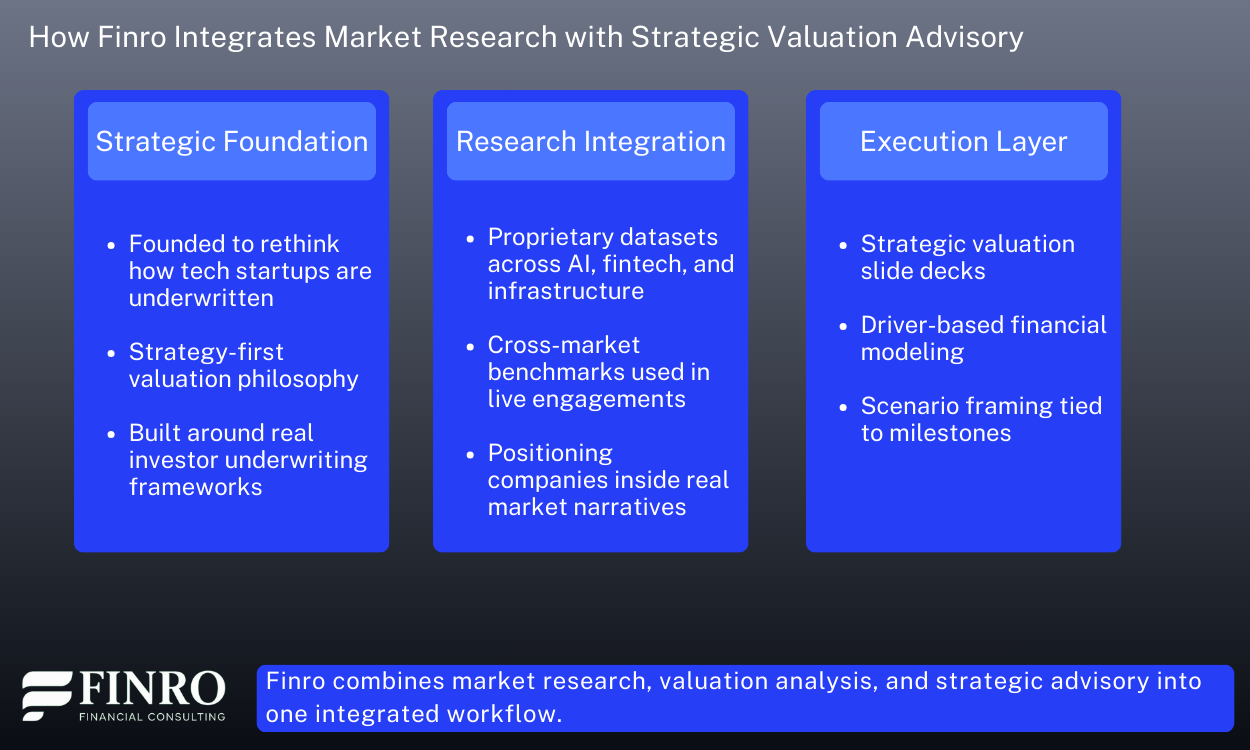
At Finro, valuation work sits at the intersection of market research and execution. The same datasets and cross-market analysis used in Finro’s AI, fintech, and infrastructure research are applied directly to client engagements, helping founders and investors move from headline multiples to defensible valuation narratives.
Instead of rigid, one-size-fits-all valuation processes, Finro focuses on tailored frameworks built around your business model, growth profile, and strategic objectives, combining market benchmarks with practical advisory support.
Below is how we run valuations for tech companies and what founders typically get wrong when they benchmark multiples.
Topics covered in this article +
- The Need for Tailored Valuation Services
- Related Startup Valuation Guides and Advisory Services
- Finro: A Smarter Approach to Tech Startup Valuations
- Our Story: The Finro Journey
- How Finro Builds Investor-Grade Valuation Deliverables
The Need for Tailored Valuation Services
Many traditional valuation processes were built for mature businesses. Early-stage and growth-stage tech companies operate differently, which is why template-driven approaches often miss how value is actually created.
Tech startups operate with unique business models, often featuring business-specific revenue streams, niche markets, and groundbreaking ideas. Traditional valuation methods can overlook these crucial aspects, leading to undervalued assessments that don't accurately reflect the true potential of your startup. Investors increasingly evaluate startups through an underwriting lens rather than pure growth narratives, which means revenue quality, scalability signals, and positioning inside a market narrative matter as much as headline growth.
For tech startups, understanding these unique elements is not just beneficial; it's essential. A tailored valuation approach recognizes the individuality of each tech startup, ensuring that the valuation captures the full spectrum of the business’s value. This approach not only provides a more accurate assessment but also supports better decision-making for investors and founders alike.
At Finro, valuation work starts with strategic context and positioning before any model is built. This means considering industry-specific KPIs, understanding market trends, and applying valuation techniques that align with the startup's growth trajectory.
By taking this approach, valuation becomes more than a number. It becomes a strategic framework that connects today’s traction with a credible path to future valuation outcomes. This level of precision helps founders attract the right investors and position their company inside a defensible market narrative.
Finro: A Smarter Approach to Tech Startup Valuations
Many of the valuation themes discussed across Finro’s AI, fintech, infrastructure, and vertical SaaS research originate in real advisory work with founders, investors, and corporate acquirers. The same datasets, market benchmarks, and underwriting lens used in our public research are applied inside engagements to turn market signals into valuation decisions.
Unlike traditional Big-4 valuation processes built around rigid templates and long timelines, Finro’s work is structured around startup-specific underwriting signals and real market positioning. We start with the business logic behind the numbers: how the company acquires and retains customers, what expands margins over time, what the next credible milestones are, and what an investor or buyer will actually underwrite.
What founders typically use Finro for
Pressure-test valuation ranges against public comps, private rounds, and deal benchmarks
Build a driver-based valuation framework that ties outcomes to strategy and milestones
Translate analysis into an investor-ready valuation narrative and strategic slide deck
A deliverable that investors can use
Finro’s output is typically a strategic valuation slide deck supported by analysis, benchmarks, and scenario work. It is built to communicate strengths, growth drivers, risks, and the path from today’s traction to future outcomes in a way that matches how investors and acquirers evaluate deals.

A clear, scalable financial framework that made our model Series A-ready.
We had the pleasure of working with Lior Ronen and Finro on rebuilding our WAAS financial model to make it Series A-ready.
Lior was exceptionally professional, knowledgeable, and responsive from day one. He quickly understood the complexity of the WAAS ecosystem and translated our B2B4C rental model, including hardware, software, and services, into a clear, scalable financial framework.
The result is a robust, investor-proof model that truly reflects how our business operates and grows. I appreciated how engaged and solution-oriented he was throughout the process.
Thank you, Lior and the Finro team, for your collaboration and valuable contribution to our next stage of growth.
Our Story: The Finro Journey
Finro Financial Consulting was founded to close a gap many founders experience when preparing for funding or strategic decisions. Traditional valuation frameworks were built for mature businesses and rarely reflect how modern tech companies are actually underwritten.
After years of working on technology investments, M&A analysis, and financial strategy inside large technology organizations, Lior Ronen built Finro around a different philosophy. Valuation should not be a static report delivered at the end of a process. It should function as an advisory framework that helps founders understand how investors think, how multiples move across markets, and how financial narratives translate into real outcomes. This philosophy emerged from seeing how many founders struggled with rigid valuation frameworks that failed to reflect startup dynamics or investor underwriting expectations.
Since 2014, Finro has supported more than 200 startups and investors across AI, fintech, API infrastructure, proptech, cybersecurity, and vertical SaaS. Over time, the work evolved beyond traditional valuation assignments into a broader ecosystem combining market research, proprietary datasets, financial modeling, and transaction-focused advisory.
Today, Finro operates at the intersection of research and execution, helping founders turn complex financial signals into positioning strategies that hold up under real underwriting.
How Finro Builds Investor-Grade Valuation Deliverables
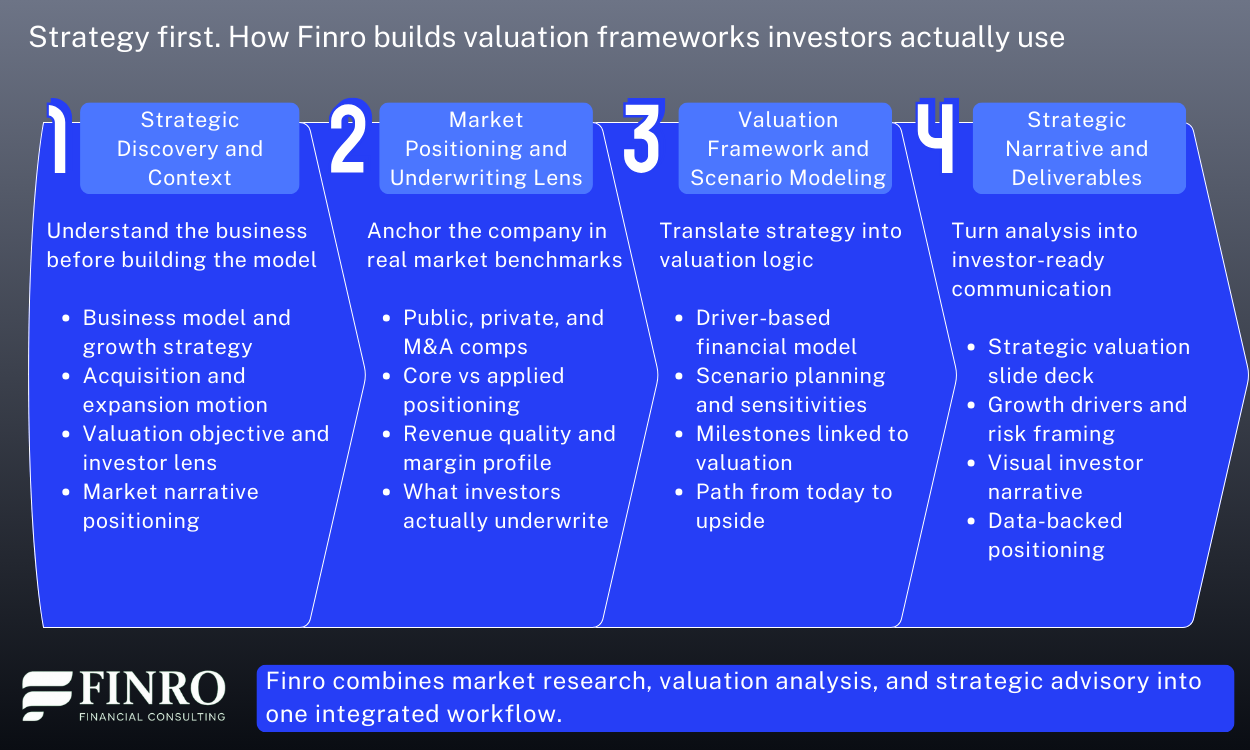
Most valuation firms start with templates and adjust the numbers afterward. Finro’s process is intentionally designed to avoid generic, template-driven valuation workflows that often fail to reflect how investors actually assess growth-stage companies.
At Finro, the process begins by understanding how the business actually grows, how investors are likely to underwrite it, and what the valuation needs to achieve.
The objective is not to produce a static report. It is to build a strategic valuation narrative rooted in real execution, market positioning, and defensible assumptions.
Strategic Discovery and Context
Every engagement starts with a focused discussion around how the company operates today and where it intends to go.
This includes how customers are acquired, what drives expansion, which milestones matter most, and whether the valuation supports fundraising, M&A positioning, or internal strategy.
Instead of forcing companies into predefined models, the goal is to understand the logic behind the business before building anything quantitative.
Market Positioning and Underwriting Lens
Once the strategic context is clear, we map the company against the market.
This step draws on Finro’s research across AI, fintech, infrastructure, and vertical SaaS to identify the right peer set and underwriting framework.
Rather than applying broad industry averages, we focus on where value accrues inside the stack, how revenue quality is interpreted, and which metrics investors actually prioritize.
Positioning is often what separates similar companies that achieve very different valuation outcomes.
Valuation Framework and Scenario Modeling
With positioning defined, we develop a valuation framework that connects operational performance to market expectations.
Financial modeling, KPI analysis, and scenario work are used to illustrate how growth, efficiency, and execution influence valuation ranges over time.
The emphasis is on clarity rather than complexity, helping founders and investors understand what drives value and what needs to improve.
This stage transforms market benchmarks into a structured, decision-ready view of the business.
Strategic Valuation Narrative and Deliverables
The final deliverable is typically a strategic valuation slide deck designed to support real conversations with investors, boards, or acquirers.
Instead of a technical report, the output highlights:
core strengths and differentiation
growth trajectory and milestones
underwriting risks and opportunities
how today’s execution connects to future potential
Every engagement is shaped around the company’s strategy and the questions stakeholders actually care about.
Case Studies and Testimonials
Across different stages and sectors, Finro’s valuation work focuses on translating complex market signals into positioning strategies that founders and investors can actually use.
Rather than treating valuation as a standalone report, these engagements reflect how underwriting frameworks, strategic narratives, and financial modeling come together in practice.
Princap: Building an Underwriting Lens for a Pre-Revenue Investment
Princap required deep market analysis to evaluate a pre-revenue technology company where traditional financial benchmarks were limited. Finro structured the engagement around comparable positioning, emerging market signals, and forward-looking valuation logic, helping the investment team anchor decision-making beyond headline multiples.
Mick Carolan, General Partner at Princap, noted:
“Lior has consistently delivered analysis of both depth and accuracy… His synthesis of large data sets into actionable intelligence based on key comps has been instrumental in refining our investment strategy.”
Spaceling: Turning Financial Complexity into Investor-Ready Positioning
Spaceling approached Finro ahead of its seed funding process, requiring a valuation framework that aligned product strategy, market positioning, and financial modeling. Instead of delivering a static valuation report, the work focused on building a structured financial narrative supported by scenario analysis and investor-grade materials.
Michael Sperling, Co-Founder and CEO of Spaceling, shared:
“Lior has been truly a pleasure to work with… a professional and master of his craft, precise and extremely approachable.”
Tropos AR: Valuing Innovation During Emerging Market Cycles
Operating during the Web3 cycle, Tropos AR needed guidance navigating a fast-shifting market narrative. Finro combined market research with long-term positioning analysis, helping frame the company’s technology inside broader valuation trends rather than short-term hype cycles.
Sven Van de Perre, Co-Founder of Tropos AR, noted:
“Finro helped us navigate that future like few others can… one of the very few companies that had a correct view of the leap in technology.”
Broad Street Global Fund: Structuring Pre-IPO Investment Decisions
For Broad Street Global Fund, valuation work centered on assessing opportunities where limited public data existed. Finro developed an underwriting framework that connected market comparables, strategic positioning, and risk framing, supporting more informed investment decisions.
Joseph Baldassarra, Managing Partner, commented:
“Lior and Finro’s guidance made a significant difference in our success… always intelligent and always within budget.”
These engagements illustrate how valuation becomes a strategic advisory tool rather than a static deliverable. By combining research, financial modeling, and narrative positioning, Finro helps founders and investors align market benchmarks with real execution.
Thinking About Your Next Valuation Step?
Share your stage, context, and objective. We’ll help frame the valuation logic, identify the assumptions that matter, and clarify where investors or buyers are likely to focus.
A 15 to 20 minute strategy call to understand the valuation context and define the right scope.
Working With Finro: How Strategy Turns Into Investor-Ready Outcomes
Working with Finro is designed to feel less like a traditional consulting engagement and more like a strategic collaboration. Rather than delivering isolated valuation outputs, the process focuses on aligning founders and investors around a clear underwriting narrative built on real market signals.
Strategic Alignment From Day One
Every engagement begins with an open strategic dialogue. Founders bring their roadmap, positioning goals, and growth assumptions, while Finro brings market context, comparable signals, and valuation frameworks shaped by real investor behavior. This collaborative foundation ensures the work reflects how decisions are actually made in funding and M&A environments.
Transparent Thinking, Not Black-Box Analysis
Throughout the process, founders remain close to the logic behind every assumption. Instead of presenting a finished model at the end, Finro works iteratively, explaining how positioning, revenue mechanics, and market benchmarks influence valuation outcomes. This transparency helps teams internalize the strategic drivers behind the numbers.
Advisory That Evolves With the Company
As discussions progress, the focus often shifts beyond valuation itself. Topics such as investor messaging, milestone framing, and growth narrative positioning naturally become part of the conversation. The goal is not only to deliver a framework, but to leave founders with a clearer understanding of how to communicate their company’s trajectory with confidence.
Working with Finro means combining analytical rigor with practical advisory support, helping founders move from uncertainty around valuation to a structured narrative that stands up to real underwriting scrutiny.
Conclusion
Navigating startup valuation today is no longer about applying a generic multiple or producing a static report. Across AI, fintech, infrastructure, and vertical SaaS, investors increasingly evaluate companies through an underwriting lens, where positioning, revenue mechanics, and strategic narrative matter as much as headline growth.
At Finro, valuation work is built as an integrated advisory process. Market research, financial modeling, and strategic positioning come together to create investor-grade valuation frameworks founders and investors can actually use. Instead of focusing only on numbers, the goal is to connect today’s traction with a credible path toward future value.
From strategic discovery and market positioning to scenario modeling and investor-ready deliverables, Finro helps founders move from uncertainty to clarity. The result is not just a valuation outcome, but a framework that supports fundraising, M&A conversations, and long-term decision making.
If you are preparing for a funding round, evaluating strategic options, or building a valuation narrative that holds up under real scrutiny, Finro provides the structure and insight needed to move forward with confidence.
Built for Teams That Need More Than a Generic Valuation Number
This article is for founders, investors, and finance teams that need a clearer valuation framework for a tech startup, not just another benchmark pulled from a generic market report.
Early-stage and growth-stage tech founders
For founders preparing for a funding round, strategic discussion, board update, or valuation conversation with investors.
Startups without meaningful revenue history
For companies that need to explain valuation through product readiness, market opportunity, monetization logic, and milestone-based underwriting.
Teams with existing financial models
For startups that need to pressure-test assumptions, improve investor readability, connect projections to benchmarks, and clarify valuation logic.
Investors and corporate development teams
For teams evaluating startup opportunities and looking for a structured view of market positioning, valuation range, growth assumptions, and execution risk.
Founders preparing for strategic discussions
For founders who need to understand how buyers may evaluate scale, strategic fit, revenue quality, integration risk, and comparable transactions.
Finance leaders and operators
For teams building investor-grade materials for fundraising, internal planning, board discussions, or strategic decision-making.
- 1 Startup valuation today is not just a multiple exercise. Investors look at positioning, revenue quality, growth efficiency, risk, and the logic behind the financial model before they accept a valuation range.
- 2 Generic valuation reports often miss the real investor conversation. A startup does not only need a valuation number. It needs a clear explanation of why that number is defensible.
- 3 Investor-grade valuation work combines market data, financial modeling, and strategic narrative. The strongest valuation deliverables connect comps, projections, scenarios, and business positioning into one coherent framework.
- 4 Finro focuses on underwriting logic rather than static benchmark tables. The goal is to help founders and investors understand how the market would actually evaluate the company, not just what a broad average multiple suggests.
- 5 Cross-market research matters in startup valuation. AI, fintech, cybersecurity, API infrastructure, PropTech, and vertical SaaS companies are not priced the same way, even when they all fall under the broader tech category.
- 6 A strong valuation process should support fundraising, M&A, and internal planning. The output should help founders explain the company, defend assumptions, and make better strategic decisions.