
AI Can Build Your Startup Financial Model. But It Can’t Make It Investor-Ready.
A growing number of tools and courses promise to help founders build a startup financial model with AI.
Claude for Excel, GPT-generated templates, and automated forecasting tools. Some of them are genuinely useful. They can generate spreadsheet structures, formulas, and even financial statements in minutes.
But there is an important distinction that often gets missed.
Investors rarely scrutinize the spreadsheet itself. They scrutinize the logic underneath it.
When investors review a financial model, they are trying to understand how the business actually works. What drives revenue growth? How do unit economics evolve as the company scales? Which costs create operating leverage, and which ones grow with the business?
A well-formatted spreadsheet that cannot answer those questions clearly will not survive a serious diligence conversation.
AI can quickly generate a model structure. But building a model that holds up under investor scrutiny requires something else: understanding how investors evaluate companies.
That is the difference between a financial model that looks right and one that works.
-
AI can generate the spreadsheet. It cannot validate the business logic. AI tools can produce clean financial models quickly, but investors do not evaluate the spreadsheet itself. They evaluate the commercial logic behind the numbers.
-
Investor-ready models need operating drivers, not just formulas. A credible model connects customer acquisition, pricing, unit economics, operational capacity, hiring needs, and capital requirements into one coherent framework.
-
The model should explain how the business grows. When the drivers are clear, the model shows how funding supports growth, where constraints appear, and which assumptions investors are most likely to challenge.
Topics covered in this article +
- Why AI-Generated Financial Models Look Convincing
- What Investors Actually Examine in a Financial Model
- Where AI-Generated Financial Models Usually Break
- How Investor-Ready Financial Models Are Actually Built
- AI Can Build a Spreadsheet. It Can’t Replace the Logic Behind It.
- Financial Modeling Resources
- Key Takeaways
- Answers to the Most Asked Questions
Why AI-Generated Financial Models Look Convincing
AI tools have become very good at generating the structure of a financial model.
Give a prompt and you’ll often get a spreadsheet that looks surprisingly polished: separate tabs, formulas, financial statements, and even charts. For founders building a model for the first time, this can feel like a major breakthrough.
And in some ways it is. AI can save hours of spreadsheet work.
But most of what these tools generate is structure, not logic.
A typical AI-generated model will include the familiar components:
revenue projections
cost assumptions
an income statement
cash flow forecasts
On the surface, everything looks correct.
The problem is that these elements are often built top-down, rather than from the operational drivers that actually determine how the business grows.
Revenue may be projected as a simple growth curve.
Margins may gradually improve over time.
Costs may scale in smooth percentages.
The spreadsheet works. The formulas calculate. The model “runs.”
But none of those outputs necessarily explain how the business actually produces those numbers.
And that’s where investor scrutiny begins.
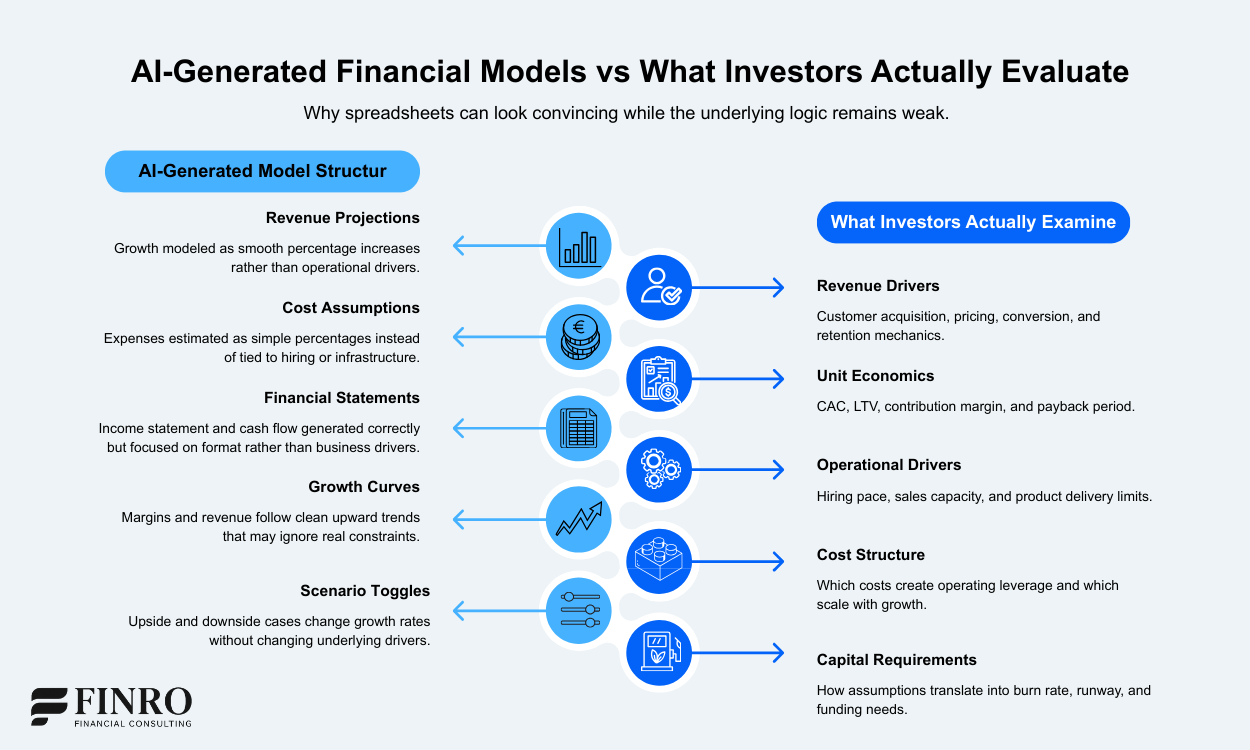
What Investors Actually Examine in a Financial Model
When investors review a startup financial model, they are not primarily checking whether the spreadsheet formulas work. They are trying to understand how the business actually produces the numbers in the model. That means looking past the financial statements and focusing on the operational logic behind them.
In practice, investors usually focus on five things.
1. Revenue Drivers
The first question is always how revenue actually happens. A strong financial model explains the mechanics behind growth: how customers are acquired, how pricing works, how conversion happens, and how retention drives expansion over time. Without these drivers, revenue projections are simply growth curves.
2. Unit Economics
Investors also examine whether the economics of each customer make sense. Metrics like customer acquisition cost (CAC), lifetime value (LTV), contribution margin, and payback period help determine whether growth creates value or simply burns capital.
3. Operational Drivers
Financial projections are always constrained by operations. Hiring pace, sales capacity, product delivery timelines, and infrastructure requirements all influence how quickly a company can realistically scale. A credible model reflects these constraints instead of assuming growth can accelerate indefinitely.
4. Cost Structure
Another key question is how costs behave as the company grows. Some costs create operating leverage and allow margins to expand, while others scale alongside revenue and limit profitability. A strong model clearly separates these dynamics.
5. Capital Requirements
Finally, investors focus on how assumptions translate into cash. Burn rate, runway, and the timing of future funding rounds become critical. A good financial model makes it easy to see how changes in hiring, pricing, or growth affect the company’s capital needs.
Together, these elements form the logic underneath the spreadsheet. And this is exactly where many AI-generated financial models begin to break down.
Already built a financial model?
Before investors review it, we do. Finro’s Investor Readiness Review helps founders pressure-test the assumptions, logic, and investor scrutiny points inside an existing financial model.
Where AI-Generated Financial Models Usually Break
AI tools can generate a clean financial model structure very quickly.
Tabs appear in the right order, financial statements balance, and outputs look polished. The problem usually isn’t the spreadsheet itself.
The problem is the logic underneath it.
1. Revenue growth without operational drivers
AI-generated models often project revenue as a smooth growth curve, but they rarely explain what actually produces that growth. Investors want to see how customers are acquired, how conversion works, how pricing translates into revenue, and how retention affects expansion over time. Without these drivers, revenue projections may look neat, but they are difficult to defend under scrutiny.
2. Unit economics that don’t connect to acquisition
Another common issue is the disconnect between customer acquisition and profitability. AI models may include CAC, LTV, and payback period, but these metrics are often calculated in isolation rather than linked to real sales and marketing assumptions. Investors expect to see a clear relationship between spend, acquisition, growth, and margin behavior. When those connections are missing, the model stops being a decision tool.
3. Cost structures that scale too smoothly
In real businesses, costs rarely grow as perfect percentages of revenue. Hiring happens in steps, infrastructure expands in chunks, and operating costs often rise before revenue catches up. AI-generated models tend to smooth these dynamics into simple ratios. Investors, however, want to see whether the model reflects the real operational constraints of scaling.
4. Scenario analysis that changes the output, not the drivers
Many AI-generated models include upside, base, and downside cases, but the scenarios often change only headline growth rates rather than the assumptions underneath them. A meaningful scenario analysis changes the actual mechanics of the business, such as conversion, acquisition cost, hiring pace, or pricing. Without that, scenarios add presentation value but limited analytical value.
AI can generate a model structure quickly. But when the underlying drivers are weak, the spreadsheet becomes hard to defend in a serious investor conversation.
What makes investors lose confidence in a financial model
These are usually the first signs that a model looks polished on the surface but lacks the operating logic underneath it.
Growth without acquisition logic
Revenue increases are shown clearly, but the path from channels, conversion, and pricing to growth is missing.
Margins without operating leverage
Profitability improves over time, but the model does not explain which costs scale efficiently and which do not.
Scenarios without driver changes
Upside and downside cases adjust headline outputs without changing the assumptions that actually produce them.
Runway without capital logic
Cash runway is visible, but the link between growth assumptions, burn, and future funding needs is unclear.
Investor conversations usually start with the model
If you are preparing a financial model for fundraising, board discussions, or strategic planning, the structure of the model matters as much as the numbers. Finro builds driver-based financial models where growth logic, unit economics, and capital requirements are fully connected.
Explore Financial Modeling ServicesHow Investor-Ready Financial Models Are Actually Built
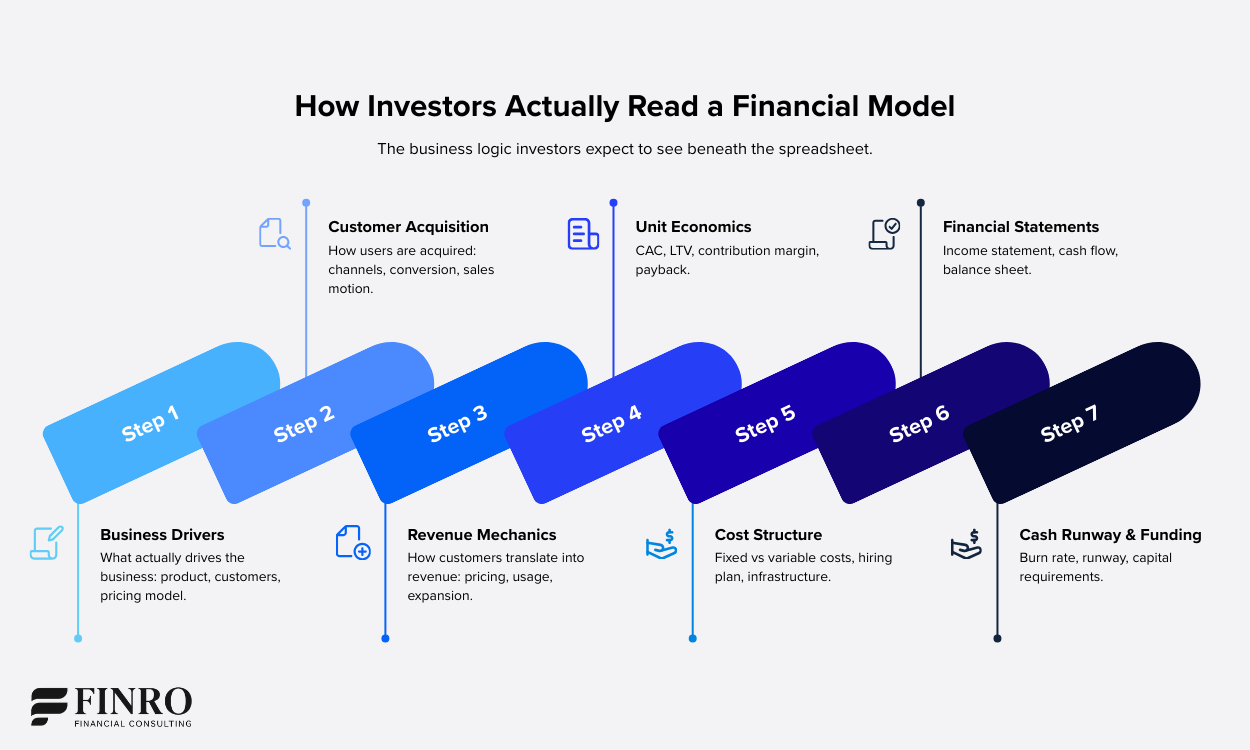
A financial model that survives investor scrutiny is not defined by how the spreadsheet looks, but by how clearly the business logic flows through it. Strong models start with the operational drivers of the company and build financial outcomes from there. Instead of projecting growth first and filling in assumptions later, investor-ready models work from the mechanics of the business upward.
1. Start with business drivers
Every credible financial model begins with the drivers that actually produce revenue. This means defining how customers are acquired, how pricing works, how usage or retention affects growth, and how those variables evolve over time. When the drivers are clear, the revenue model becomes a natural output of the business rather than a top-down assumption.
2. Connect revenue to acquisition and pricing
Revenue should always be linked to the mechanisms that generate it. Customer acquisition channels, conversion rates, pricing models, and expansion dynamics all shape how revenue grows. When these elements are connected in the model, changes to assumptions immediately show their impact on growth and capital needs.

3. Build unit economics into the structure
Unit economics are not separate metrics that appear at the end of a spreadsheet. They should be embedded directly in the model. Customer acquisition cost, lifetime value, contribution margin, and payback period should all evolve naturally from the same assumptions that drive revenue and spending.
4. Reflect operational constraints
Real businesses scale through people, infrastructure, and execution capacity. Hiring plans, sales productivity, and product delivery timelines all influence growth. Investor-ready models reflect these constraints instead of assuming that revenue can increase smoothly without operational limits.
5. Translate assumptions into cash and runway
Ultimately, investors want to understand how assumptions translate into capital requirements. A strong model makes it easy to see how hiring, growth, and pricing affect burn rate, runway, and the timing of future funding rounds. This connection between strategy and cash is what turns a financial model into a decision tool.
When these pieces are connected, the spreadsheet stops being just a set of projections. It becomes a structured explanation of how the business grows and how capital supports that growth.

We worked with Lior Ronen and Finro to rebuild our WAAS financial model and make it Series A-ready.
Lior quickly understood the complexity of our B2B4C rental model combining hardware, software, and services, and translated it into a clear and scalable financial framework.
The result is a robust, investor-ready model that truly reflects how our business operates and grows.
AI Can Build a Spreadsheet. It Can’t Replace the Logic Behind It.
AI tools are becoming increasingly capable at generating financial model structures. With the right prompt, a founder can produce a spreadsheet with revenue forecasts, cost assumptions, and financial statements in minutes.
That is genuinely useful. It lowers the barrier to building an initial model and can save significant time during early planning.
But the spreadsheet itself is only the surface.
Investors don’t evaluate financial models by looking at formulas or formatting. They evaluate the logic underneath the numbers. They want to understand how revenue is actually generated, how unit economics evolve as the company scales, and how assumptions translate into capital requirements.
When those drivers are clear, the financial model becomes more than a projection. It becomes a structured explanation of how the business grows and how capital supports that growth.
AI can help generate the spreadsheet.
But building a model that survives investor scrutiny still requires understanding how investors think about businesses, risk, and growth dynamics.
And that is the difference between a financial model that looks right and one that actually works.
Financial Modeling Resources
Guides, frameworks, and services for building financial models that hold up in investor conversations.
- 1 AI can generate spreadsheet structure. Modern AI tools can quickly create financial model layouts, formulas, and basic projections.
- 2 Investors evaluate the logic underneath. Investor scrutiny focuses on how assumptions connect to real business drivers, not whether the spreadsheet looks clean.
- 3 Revenue must be tied to drivers. Acquisition channels, pricing mechanics, conversion, and retention determine how growth actually happens.
- 4 Unit economics matter more than growth curves. CAC, LTV, contribution margin, and payback determine whether growth creates value or simply burns capital.
- 5 Operational constraints shape projections. Hiring pace, sales capacity, and infrastructure limits influence how quickly companies can scale.
- 6 Investor-ready models connect strategy to cash. Strong models clearly translate assumptions into burn rate, runway, and future capital needs.