
Startup Financial Models: What a Second Look Reveals
At first glance, many startup financial models look convincing. The spreadsheet is structured properly, the projections extend five years into the future, and the numbers appear internally consistent. For founders preparing to raise capital, this can create a sense of confidence that the financial story is ready for investor discussions.
But a startup financial model often reveals more when someone takes a second look.
In most cases, the formulas themselves are not the problem. Modern tools, and increasingly AI, can generate financial model structures quickly. The real questions usually sit underneath the spreadsheet: where revenue growth actually comes from, how customer acquisition evolves as the company scales, and whether the projected margins and hiring plans match the operational reality of the business.
When investors review a startup financial model, this is exactly where their attention goes. They are not checking whether the spreadsheet calculates correctly. They are testing whether the assumptions behind the projections make sense.
A careful second look at a startup financial model often reveals patterns that are difficult to see while building it. Certain assumptions appear stronger than they are. Some operational constraints are missing from the projections. And occasionally, the model answers questions that investors are unlikely to ask, while leaving the important ones unresolved.
The sections below explore the types of issues that frequently appear when a startup financial model is reviewed from an investor perspective.
-
01A strong financial model is not defined by clean projections. A model can look polished and still fail investor scrutiny if the assumptions are not connected to real business drivers.
-
02Revenue only becomes credible when it is operationally grounded. Growth assumptions need to connect to customer acquisition, conversion, retention, pricing, sales capacity, and rollout constraints.
-
03Margins need to be supported by actual cost behavior. Improving margins are only defensible when the model explains what changes operationally, including delivery costs, headcount leverage, pricing power, or infrastructure efficiency.
-
04Hiring plans must match growth capacity. Revenue, onboarding, support, implementation, sales, and product delivery should scale with the people and resources required to support that growth.
-
05A second review often reveals where the model is too smooth. The biggest issues usually appear in assumptions that look reasonable at first glance but are not supported by evidence, operating logic, or business constraints.
Topics covered in this article +
- The revenue curve that looks too clean
- Customer acquisition costs that stay flat
- Retention assumptions that haven’t been proven yet
- Margins that expand too quickly
- Hiring plans that ignore operational constraints
- Why founders often miss these issues
- What a second look reveals
- Key takeaways
- Related articles
- Answers to the most asked questions
The Revenue Curve That Looks Too Clean
One of the first patterns that appears when reviewing a startup financial model is a revenue curve that looks unusually smooth. Month after month, the numbers climb steadily upward, often accelerating at a predictable pace. At first glance this seems encouraging. Consistent growth suggests a business that is scaling efficiently.
In practice, however, real revenue rarely behaves this way.
Early-stage companies typically experience uneven growth as they develop their sales process. Customer acquisition depends on experiments with different channels, changes in pricing, and adjustments to the sales cycle. Some months bring larger deals or unexpected momentum, while others reveal bottlenecks in lead generation, onboarding capacity, or product readiness. These variations tend to create fluctuations that are difficult to smooth out entirely.
For this reason, investors often look beyond the revenue line itself and ask a more fundamental question: what operational drivers produce the curve in the first place?
A revenue forecast that grows steadily without clearly connecting to sales capacity, marketing investment, or conversion rates can quickly raise questions. How many deals are required to reach those numbers? How long does the sales cycle last? How quickly can the team realistically add new customers?
When the model does not answer these questions clearly, the projections may still calculate correctly, but the underlying logic becomes difficult to defend. A second look at the revenue curve often reveals whether the model reflects the actual mechanics of how the company expects to grow.
How investors look at revenue projections
Investors do not usually challenge the revenue curve first. They challenge the operating logic behind it, including the sales capacity, acquisition channels, conversion assumptions, and sales cycle required to make the forecast real.
- Smooth revenue growth curve
- Revenue increases steadily each month
- Limited connection to sales capacity
- Growth not tied clearly to marketing investment
- Sales cycle assumptions not visible
- What operational drivers produce this growth?
- How many deals are required to reach these numbers?
- How many sales reps generate this revenue?
- Which acquisition channels drive new customers?
- How long does the average sales cycle actually take?
Modeling takeaway: A credible revenue forecast should show the path from acquisition activity to signed customers, not just the final revenue line.
Need a financial model investors can interrogate? Finro builds driver-based startup financial models that connect revenue, hiring, margins, and funding needs to real operating assumptions.
Explore financial modelingCustomer Acquisition Costs That Stay Flat
Another assumption that often looks reasonable at first glance is customer acquisition cost that remains broadly unchanged over time. In many startup financial models, CAC is either held flat or allowed to improve gradually in a very smooth way. On the surface, this creates a clean relationship between growth and efficiency.
In practice, customer acquisition rarely behaves so neatly.
As a company scales, acquisition channels usually become less efficient, not more. Early growth often comes from the easiest customers to reach: warm introductions, founder-led sales, highly responsive early adopters, or underpriced channels that have not yet been saturated. As volume increases, the business typically has to spend more to reach the next layer of customers, build out the sales function, or invest more heavily in marketing infrastructure.
This is why investors tend to look closely at how CAC evolves over time rather than accepting a single number at face value. They want to understand whether the model reflects changes in channel mix, sales team expansion, conversion rates, and payback periods as the company grows.
A second look at CAC assumptions often reveals whether the model has been built around real acquisition mechanics or whether the economics have been simplified for the sake of a cleaner forecast.
Retention Assumptions That Haven’t Been Proven Yet
Retention is another area where financial models often appear convincing but lack real operational support. Early-stage models frequently assume stable or gradually improving retention rates even when the company has very limited historical data.
In reality, retention is one of the hardest metrics to forecast because it depends on product value, customer fit, onboarding quality, pricing, and competitive alternatives. Small changes in retention assumptions can dramatically affect lifetime value and the overall economics of the business. Investors know this, which is why they tend to scrutinize retention assumptions carefully.
When a model assumes strong long-term retention without clear evidence or operational reasoning, it quickly raises questions about whether the growth projections are grounded in actual customer behavior.
For example, a SaaS startup might assume that annual customer retention will stabilize at 90% within two years. On paper this produces a very attractive lifetime value and strong unit economics. But when investors ask how that retention will be achieved, the model often has no operational explanation.
There is no clear onboarding process, no customer success function, and no evidence yet that customers actually stay that long. The assumption exists in the spreadsheet, but not yet in the business.
How robust is your financial model before investor review?
Investors usually do not challenge one assumption in isolation. They test whether retention, acquisition, margins, hiring, and runway behave like one connected business model.
Retention questions investors often ask
- What historical retention data supports this assumption?
- How does retention differ across customer segments?
- What operational changes will improve retention over time?
- What happens to the model if retention drops by 5 to 10%?
Full model self-check before fundraising
- Can every revenue assumption be traced to a real acquisition channel or pricing driver?
- Do CAC and retention assumptions reflect realistic scaling dynamics?
- Do margins expand because of operational changes, not just spreadsheet logic?
- Does the hiring plan match the company’s ability to acquire and serve customers?
- Can the model explain capital needs and runway under different scenarios?
Modeling takeaway: Because retention directly shapes lifetime value, even small assumption changes can materially alter customer economics, fundraising needs, and the valuation story.
Need an external review before investor discussions? Finro reviews startup financial models for assumption logic, investor readiness, scenario structure, and valuation support.
See how the review worksMargins That Expand Too Quickly
Another pattern that often appears in early-stage financial models is gross or operating margins that improve steadily over time without a clear operational explanation. In theory, margins should expand as companies scale, benefit from efficiencies, and spread fixed costs across a larger revenue base. In practice, margin expansion rarely follows a smooth upward curve.
Growing companies often need to invest in customer support, infrastructure, marketing, and product development long before efficiencies fully materialize. When a financial model assumes rapid margin improvement without tying it to specific operational changes, investors tend to question whether the projections reflect realistic scaling dynamics.
In many cases, the spreadsheet shows improving margins simply because costs are modeled as a declining percentage of revenue. But investors usually want to understand what actually drives that improvement.
Are hosting costs falling because of infrastructure optimization? Is customer support becoming more efficient due to automation? Are sales processes improving conversion rates? Without clear drivers, margin expansion can appear less like operational progress and more like spreadsheet arithmetic.
What actually drives margin expansion
Margin expansion should not appear automatically because revenue grows. Investors usually expect the model to explain which operating changes make higher margins possible.
01 What the spreadsheet often assumes
- Costs decline as a percentage of revenue
- Margins improve steadily each year
- Growth automatically creates efficiency
- Operating leverage appears naturally
02 What actually creates margin expansion
- Infrastructure optimization
- Improved pricing power
- Automation and tooling
- Operational process improvements
- Product maturity and scale advantages
Modeling takeaway: Margin expansion is credible when the model shows the operational reason behind the improvement, not only a lower cost percentage over time.
Hiring Plans That Ignore Operational Constraints
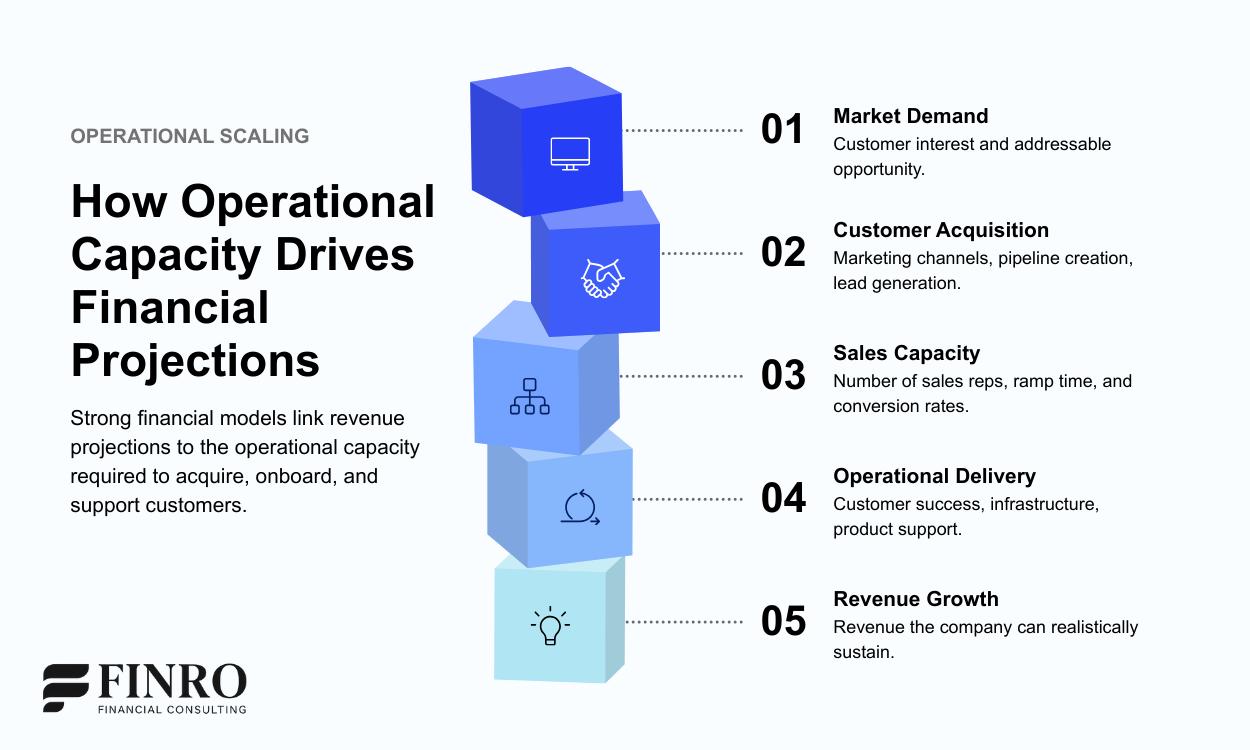
Another issue that often appears in financial models is a revenue trajectory that grows much faster than the company’s operational capacity.
In many spreadsheets, hiring plans are modeled as simple headcount increases over time, without clearly linking those hires to the company’s ability to acquire, onboard, and support customers. In reality, scaling revenue usually requires coordinated growth across several functions: sales, customer success, product, infrastructure, and operations.
If a model projects rapid revenue expansion while hiring grows slowly or remains loosely defined, investors tend to question whether the organization could realistically support that growth.
This becomes particularly visible in sales-driven businesses. Revenue projections may assume a steady increase in customers or contracts, but the model does not show how many salespeople are required to generate those deals, how long new hires take to ramp up, or how much pipeline activity is needed to sustain the growth.
Without these operational links, the financial model may appear mathematically consistent while still leaving an important question unanswered: does the company actually have the capacity to execute the plan it is projecting?
In strong financial models, hiring plans are tied directly to operational drivers.
Sales teams are linked to pipeline generation and conversion rates, customer success teams scale with the number of active accounts, and infrastructure or support costs grow alongside product usage. When these connections are visible in the model, investors can see how the business scales operationally rather than just financially.
Why Founders Often Miss These Issues
Building a financial model is rarely a purely analytical exercise. In most early-stage startups, the model is created by the founders themselves, often alongside building the product, speaking with customers, and preparing for fundraising. As a result, the spreadsheet usually reflects how the founders currently understand the business rather than how the business will ultimately operate at scale.
This is not necessarily a problem. Early financial models are supposed to evolve as the company learns more about its market, pricing, and customer behavior. But assumptions written early in the process often remain in place longer than they should. Once the model starts producing coherent projections, it becomes easy to accept the outputs without revisiting the mechanics behind them.
Another reason these issues appear is perspective. Founders usually approach the model as a strategic planning tool — a way to map out the company’s future growth. Investors, on the other hand, review the same spreadsheet through a different lens. Their goal is not simply to understand the story of the business, but to identify where the assumptions may break under pressure.
That difference in perspective explains why many founders only discover the weakest parts of their financial model during investor conversations. Questions about customer acquisition, retention, hiring capacity, or margin assumptions tend to surface during diligence meetings, when the spreadsheet is examined by someone whose role is to challenge the logic rather than build the narrative.
What a Second Look Reveals
When a financial model is reviewed from an external perspective, the focus shifts from whether the spreadsheet works to whether the underlying assumptions hold up. The structure of the model usually remains intact. What changes is how each assumption is examined, connected, and challenged.
A second look typically starts by tracing revenue back to its operational drivers. Instead of accepting top-line growth as given, the review breaks it down into acquisition channels, conversion rates, pricing, and retention. This often reveals where growth depends on assumptions that have not yet been tested or where small changes could significantly affect outcomes.
From there, the review moves into unit economics. Customer acquisition cost, lifetime value, contribution margins, and payback periods are not only calculated, but stress-tested. Investors rarely rely on a single scenario. They want to understand how the model behaves if conversion slows, retention weakens, or costs increase. A structured review surfaces these sensitivities early, before they appear in investor discussions.
Operational capacity is another area that becomes clearer under a second look. Hiring plans, sales capacity, and delivery constraints are mapped against revenue expectations. This helps identify whether the organization can realistically support the level of growth projected, or whether additional investment and time would be required.
In many cases, the outcome of a second look is not a completely different model, but a clearer understanding of where the model is strong and where it needs refinement. That clarity changes how founders present their numbers. It allows them to explain not only what the model shows, but why the assumptions behind it make sense.
- 1 Financial models can look logical while still missing operational grounding. Revenue, margins, and growth assumptions may appear consistent in a spreadsheet even when the business mechanics behind them are not clearly shown.
- 2 Investors focus on how assumptions connect to reality. Acquisition channels, pricing, retention, sales capacity, hiring plans, and delivery constraints are usually where investors challenge the model first.
- 3 Small assumption changes can materially change the outcome. Retention, CAC, margins, conversion rates, and hiring capacity directly affect unit economics, runway, capital needs, and valuation support.
- 4 Strong models are built on drivers, not just projections. A defensible model links revenue to customer acquisition, pricing mechanics, customer behavior, sales capacity, cost structure, and operational execution.
- 5 Perspective changes what the model reveals. Founders often build models to plan growth, while investors review them to test assumptions, pressure points, and downside scenarios.
- 6 A second look improves clarity, not only accuracy. Reviewing the model from an external perspective helps identify weak assumptions, strengthen the financial story, and prepare for investor diligence.