Startup Financial Modeling: How Investors Actually Evaluate Your Forecast
Startup financial modeling sits at the center of almost every major startup decision, yet many founders misunderstand what a financial model is actually supposed to do.
A financial model is not simply a spreadsheet projecting revenue growth over the next five years. Investors rarely evaluate a company based on the shape of a forecast curve alone. What they look for instead is the structure underneath the numbers: the drivers that generate revenue, the mechanics that determine margins, and the capital required to support growth.
In practice, the model is not about predicting the future with precision. It is about explaining how the business operates and how it scales.
Startup financial modeling is the process of translating how a company actually operates into a financial structure that investors can evaluate.
When investors review a startup financial model, they are typically trying to answer a few fundamental questions:
What actually drives revenue expansion?
How do unit economics evolve as the company grows?
Which costs scale with usage, and which create operational leverage?
How much capital is required to reach the next stage?
When those mechanics are clear, the financial model becomes a powerful communication tool that connects strategy with financial outcomes. When they are missing, forecasts may look impressive on the surface but collapse quickly under scrutiny.
This article explains how startup financial modeling is evaluated in practice, where founders commonly misalign with investor expectations, and how a structured modeling approach can strengthen both fundraising discussions and strategic decision making.
TL;DR
Topics covered in this article
- What Startup Financial Modeling Actually Means
- What investors actually use your model for
- Where Startup Financial Models Commonly Break
- What Changes When the Model Reflects Real Business Mechanics
- When Founders Usually Need Financial Modeling Support
- How Finro Approaches Startup Financial Modeling
- Translating Structure Into Investor Confidence
- Key Takeaways
- Related Financial Modeling Resources
- Answers to The Most Asked Questions
What Startup Financial Modeling Actually Means
Startup financial modeling is often misunderstood as a forecasting exercise. Founders build spreadsheets projecting revenue growth, expenses, and funding needs over several years, assuming the model’s purpose is to estimate how the company will perform.
In reality, investors rarely treat financial models as predictions. A startup financial model is primarily a structured explanation of how a business operates.
The model translates a company’s operating mechanics into financial logic. Instead of simply projecting revenue growth, it should show what actually produces that growth. Customer acquisition, pricing, retention behavior, and usage patterns all shape how revenue evolves over time. The model connects those drivers to the financial outcomes investors evaluate.
The same principle applies to cost structure and capital requirements. Infrastructure costs, product development, sales expansion, and operational scaling do not evolve randomly. They follow patterns tied to the company’s growth strategy. A financial model should make those relationships visible.
When these drivers are clearly structured, the model becomes far more than a forecast. It becomes a framework that explains how the company scales, where operational leverage appears, and how efficiently capital is converted into growth.
This is why experienced investors often spend less time looking at the final numbers and more time understanding how the numbers are produced. The credibility of a startup financial model depends less on optimistic projections and more on whether the underlying mechanics reflect how the business actually works.
Understanding this distinction is critical because it shapes how investors evaluate financial models in practice.
What startup financial modeling translates into for investors
Investors do not evaluate spreadsheets as forecasts. They use financial models to understand how a business actually works and how risk behaves as the company scales.
| Simple forecast | Structured financial model |
|---|---|
| Revenue growth curve | Revenue drivers (volume, pricing, retention) |
| Static cost assumptions | Cost structure tied to scaling mechanics |
| Flat margin assumptions | Margin layering and improvement path |
| Limited link to operations | Operating logic visible and testable |
| Single version of the future | Scenario analysis tied to key risks |
| Built mainly for presentations | Built for diligence and decision making |
What investors actually use your model for
Investors rarely review a startup financial model to determine whether the numbers are correct. Instead, they use it to understand whether the underlying business logic is coherent and whether the growth assumptions are grounded in real operating mechanics.
A well-structured financial model helps investors quickly evaluate how revenue is generated, how costs behave as the company scales, and how capital requirements evolve over time.
In practice, most investors focus on four structural elements when reviewing a startup financial model:
Revenue drivers and operating mechanics
Sensitivity to downside scenarios
Economic behavior at scale
Fundraising logic and capital deployment
Revenue drivers are the foundation of a credible model. Investors want to understand how revenue is actually produced inside the business, whether through customer acquisition, pricing structure, usage expansion, or retention dynamics. When revenue is built from real operating drivers, growth assumptions become far easier to evaluate and challenge.
Investors also test how the model behaves when conditions deteriorate. Rather than focusing on the base case, they often examine what happens if sales cycles lengthen, conversion rates decline, or churn increases. A structured financial model makes it possible to see how these changes affect revenue, margins, and cash runway.
Another important consideration is how the company’s economics evolve as it scales. Two businesses may grow at similar rates while producing very different financial outcomes depending on how margins, infrastructure costs, and operating leverage develop over time. Investors use the model to determine whether growth strengthens the economics of the business or gradually introduces new layers of cost and risk.
Finally, the model helps investors understand the logic behind a funding round. A financial model should clearly show how capital will be deployed, what operational milestones it supports, and how those milestones position the company for its next stage of growth. When this logic is visible, the model becomes a bridge between strategy and financing decisions.
What investors look for in a startup financial model
Where Startup Financial Models Commonly Break
Most early-stage financial models do not fail because the formulas are wrong. They fail because the structure behind the numbers does not reflect how the business actually operates.
Founders often build models quickly to support fundraising conversations or internal planning. In that process, the model becomes a projection exercise rather than a structured explanation of the company’s operating mechanics.
A few patterns appear repeatedly across early-stage models.
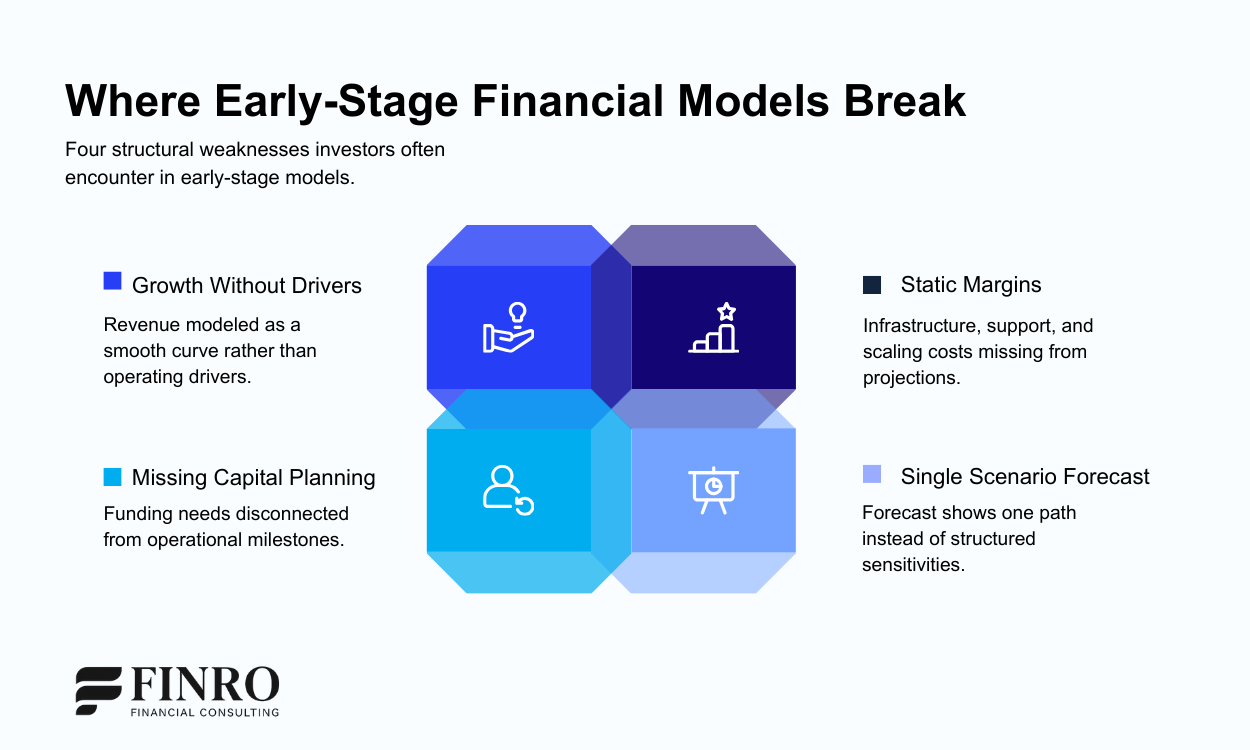
Growth without operating drivers
Static margin assumptions
Missing capital planning
Single-scenario forecasts
When revenue is modeled as a smooth growth curve, investors cannot see what actually drives expansion. Without clear drivers such as acquisition rates, pricing mechanics, or usage growth, revenue projections become difficult to evaluate.
Margins often appear stable in early models because infrastructure costs, operational scaling, and support functions are simplified. As the company grows, these cost layers tend to emerge quickly, which can significantly alter the economics of the business.
Another common issue is capital planning. A model may show revenue growth and operating expenses but fail to clearly explain how much capital is required to reach key milestones or how that capital translates into operational progress.
Finally, many models present a single path forward. In practice, investors want to understand how the business behaves under different conditions. Scenario modeling helps reveal how sensitive the company is to changes in growth, cost structure, or market timing.
When these structural elements are missing, the financial model becomes harder for investors to use as a decision-making tool.
What Changes When the Model Reflects Real Business Mechanics
When a financial model is built around the real mechanics of the business, the conversation with investors changes.
Instead of debating whether the projections are realistic, the discussion shifts toward understanding how the business operates and how its economics evolve as it grows. The model becomes less of a forecast and more of a framework for evaluating strategic decisions.
Revenue assumptions become easier to evaluate because they are tied to specific operating drivers such as customer acquisition, pricing structure, usage patterns, and retention behavior. Investors can see what actually produces growth rather than interpreting a smooth curve of projected expansion.
Margins also become easier to understand when the model reflects how costs evolve with scale. Infrastructure expenses, product development, customer support, and sales capacity all tend to follow patterns that become visible when they are modeled correctly.
Capital requirements also become clearer. Instead of presenting funding as a generic runway extension, the model shows how capital translates into operational milestones and how those milestones move the company toward the next stage of growth.
At that point, the financial model stops being a projection exercise and starts functioning as a decision-making tool. It allows founders and investors to evaluate trade-offs, understand risks, and align expectations around how the business is likely to evolve.
“We worked with Lior Ronen and Finro to rebuild our WAAS financial model and make it Series A–ready. Lior quickly understood the complexity of our B2B4C rental model combining hardware, software, and services, and translated it into a clear and scalable financial framework. The result is a robust, investor-ready model that truly reflects how our business operates and grows.”

When Founders Usually Need Financial Modeling Support
Financial modeling tends to become most valuable at moments when founders need to translate strategy into financial structure.
At the earliest stages, many companies rely on simple forecasts to communicate direction. As the business grows, however, investors, partners, and internal teams start asking more detailed questions about how revenue scales, how margins evolve, and how capital will be deployed.
These moments often trigger the need for a more structured financial model.
Common situations include:
Preparing for a fundraising round
Investors want to understand how growth is generated, how capital will be deployed, and how the business moves toward the next milestone.
Evaluating a new product or market expansion
When companies consider new revenue streams, pricing strategies, or geographic markets, financial modeling helps quantify the operational impact.
Building internal budgets and hiring plans
As teams grow, founders need a framework that connects hiring, infrastructure, and product development to revenue and margin expectations.
Preparing for investor diligence or strategic discussions
When conversations move beyond vision and into operational detail, a structured model helps align assumptions and reduce uncertainty.
In these contexts, the financial model becomes more than a spreadsheet. It acts as a shared framework that helps founders and investors understand how the business operates, how risk behaves, and how capital supports the next stage of growth.
How Finro Approaches Startup Financial Modeling
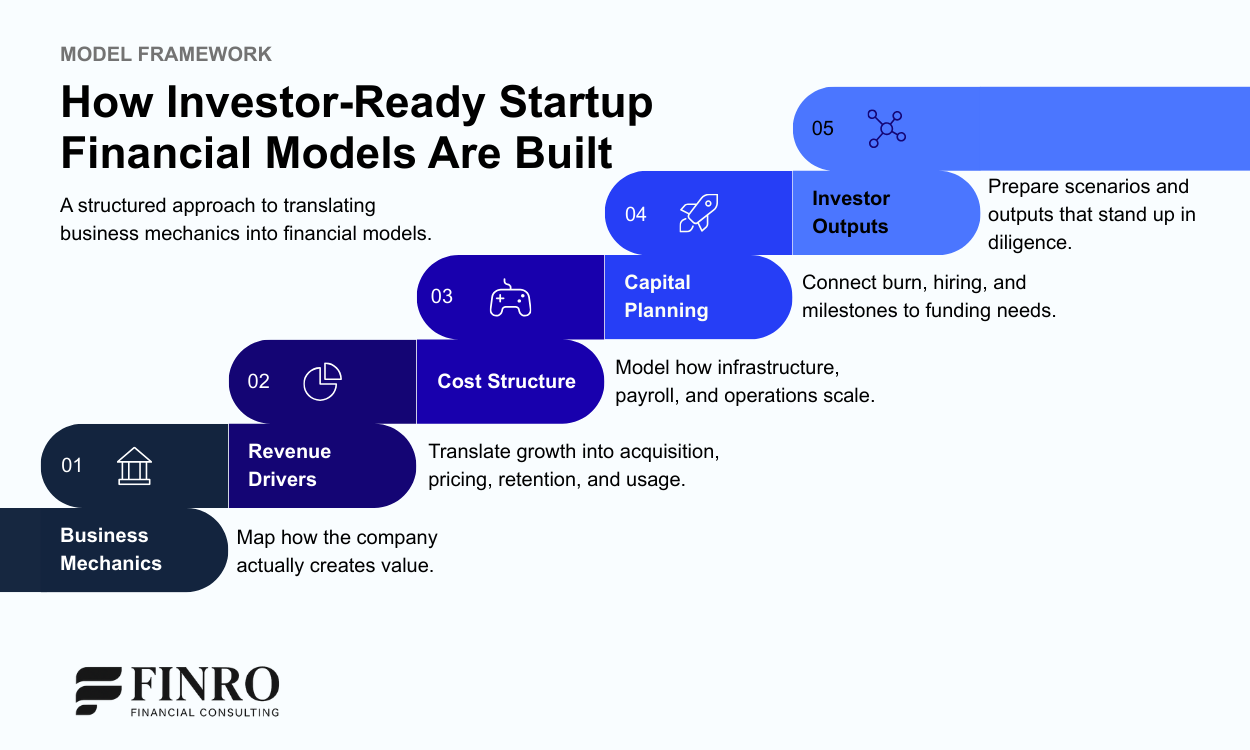
Building a useful investor-ready financial model requires more than projecting revenue and expenses. The objective is to translate the mechanics of the business into a financial structure that investors can evaluate.
At Finro, financial modeling begins with understanding how the company actually operates. That means mapping the product structure, pricing logic, and customer behavior before translating those dynamics into financial drivers. When the operating mechanics are clear, growth assumptions become easier to test and refine.
The next step focuses on the drivers behind revenue. Instead of relying on smooth growth curves, the model breaks revenue into components such as customer acquisition, retention, expansion, usage, and pricing. This approach allows founders and investors to understand how growth is generated and how changes in those drivers affect outcomes over time.
Cost structure is then layered into the model to reflect how the business scales. Infrastructure costs, product development, sales capacity, and customer support rarely grow in a linear way. Modeling these relationships explicitly makes it easier to evaluate how margins evolve as the company grows.
Capital planning is also integrated directly into the model. Hiring plans, infrastructure investment, and operational expansion are connected to funding milestones so that capital requirements reflect the company’s execution path rather than a simple runway estimate.
Finally, the model is aligned with how investors evaluate risk and opportunity. Scenarios are structured around the assumptions investors are most likely to challenge, allowing founders to demonstrate how the business performs under different conditions.
When these elements are combined, the financial model becomes more than a forecast. It becomes a framework that helps founders and investors understand how the business operates, how risk behaves, and how the company can scale in a sustainable way.
Translating Structure Into Investor Confidence
A well-built financial model does more than project revenue and expenses. It provides a structured way to explain how the business operates and how it can scale.
When the mechanics of the business are visible inside the model, conversations with investors tend to shift. Instead of debating whether the projections are realistic, the discussion moves toward understanding the assumptions that drive growth, margins, and capital needs.
Revenue becomes easier to evaluate when it is built from clear operating drivers such as customer acquisition, retention, pricing, and usage. Investors can see what needs to happen for the forecast to hold and where the risks might appear if those drivers change.
Cost structure also becomes easier to analyze when the model reflects how the company actually scales. Infrastructure costs, hiring plans, and operating expenses rarely grow in a straight line. When those relationships are visible, investors can better understand how margins evolve as the company grows.
Capital planning plays a similar role. A structured model connects the funding round to specific milestones, showing how capital supports hiring, product development, and operational expansion.
At that point, the financial model stops being a projection exercise and becomes a framework for decision making. It helps founders communicate their strategy clearly and allows investors to evaluate the company’s path forward with greater confidence.
Need a financial model that holds up in investor diligence?
A strong model makes your operating mechanics explicit, shows how unit economics behave at scale, and connects growth to capital needs. Finro builds investor-ready models for founders from Seed to Series B.
Typical next step: a 15–20 minute strategy call.
Key Takeaways
Financial models are not evaluated as forecasts. Investors use them to understand how a business operates and how risk behaves as the company scales.
Revenue projections should be built from operating drivers such as customer acquisition, pricing, retention, and expansion rather than from smooth growth curves.
Cost structure needs to reflect how the business scales. Infrastructure, hiring, product development, and support costs rarely grow in a straight line.
Capital planning should connect funding rounds to operational milestones, hiring plans, and execution timelines.
When these elements are visible, the financial model becomes a framework for decision making rather than just a projection exercise.
Answers to The Most Asked Questions
-
A startup financial model should reflect how the business actually operates. Revenue should be built from drivers such as customer acquisition, pricing, retention, and usage, while costs should reflect hiring plans, infrastructure, and operational scaling. The objective is not complexity but clarity around how growth and capital needs interact.
-
Most startups build their first structured financial model when preparing for fundraising, entering a new growth phase, or planning operational expansion. At this stage, founders need to understand hiring timelines, capital requirements, and how different growth scenarios affect runway and milestones.
-
Investors typically focus on the drivers behind revenue growth, the scalability of the cost structure, and how capital is deployed over time. They also test the model under different scenarios to understand how sensitive the business is to changes in conversion, sales cycles, retention, or infrastructure costs.
-
Most investor-ready financial models project three to five years ahead. Early years are usually modeled in greater detail, while later periods show the long-term scaling path of revenue, margins, and operating leverage.
-
Even at the early stages, a structured financial model helps founders understand how their business scales and when additional capital will be required. It also allows investors to evaluate the company’s strategy and assess whether the growth assumptions are realistic.