
Startup Financial Model Case Study: Rebuilding a Complex B2B4C Model for Series A
Building a financial model for a startup is rarely just an exercise in projecting revenue and expenses. In many cases, the real challenge is translating how the business actually operates into a financial structure that investors can evaluate.
This becomes particularly difficult when the business model combines multiple revenue streams and operational layers.
Companies that integrate hardware, software, and services often face this challenge because each component scales differently and affects margins in different ways.
This startup financial model case study explains how a complex B2B4C hardware-software business was translated into an investor-ready financial framework.
The objective was not simply to update projections, but to redesign the model so it clearly reflected how the company generates revenue, deploys capital, and scales its operations.
-
WAAS had a complex B2B4C operating model. The company combined hardware deployment, a software platform, and ongoing services, which made the financial model harder to evaluate through a standard SaaS lens.
-
The original model did not clearly separate the core drivers. Revenue, costs, hardware deployment, usage, and capital requirements were not structured in a way that made the business mechanics easy for investors to follow.
-
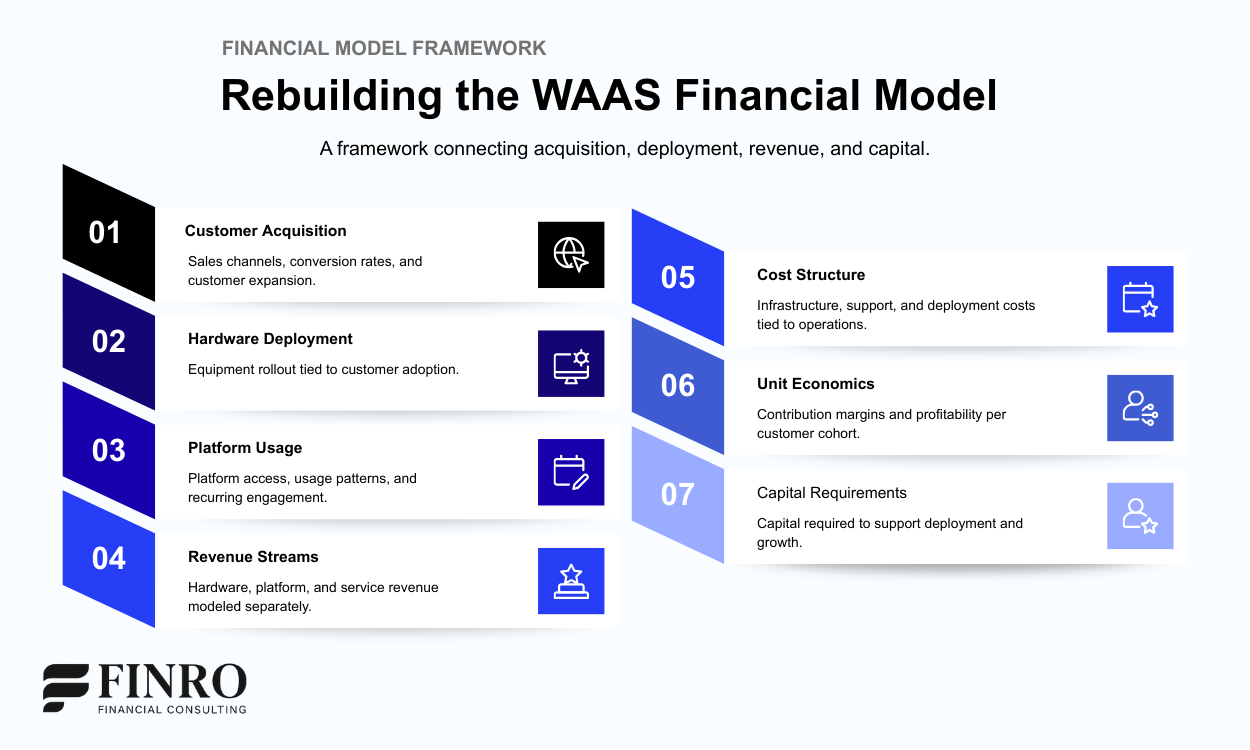
Finro rebuilt the model around how the business actually works. The rebuilt framework connected customer acquisition, hardware rollout, platform usage, operating scale, and capital needs into one clearer investor-ready model.
-
The result was a more usable fundraising framework. The new model made WAAS easier for investors to understand, evaluate, and discuss ahead of fundraising conversations.
Topics covered in this article +
Startup Financial Model Case Study: Understanding the WAAS Business Model
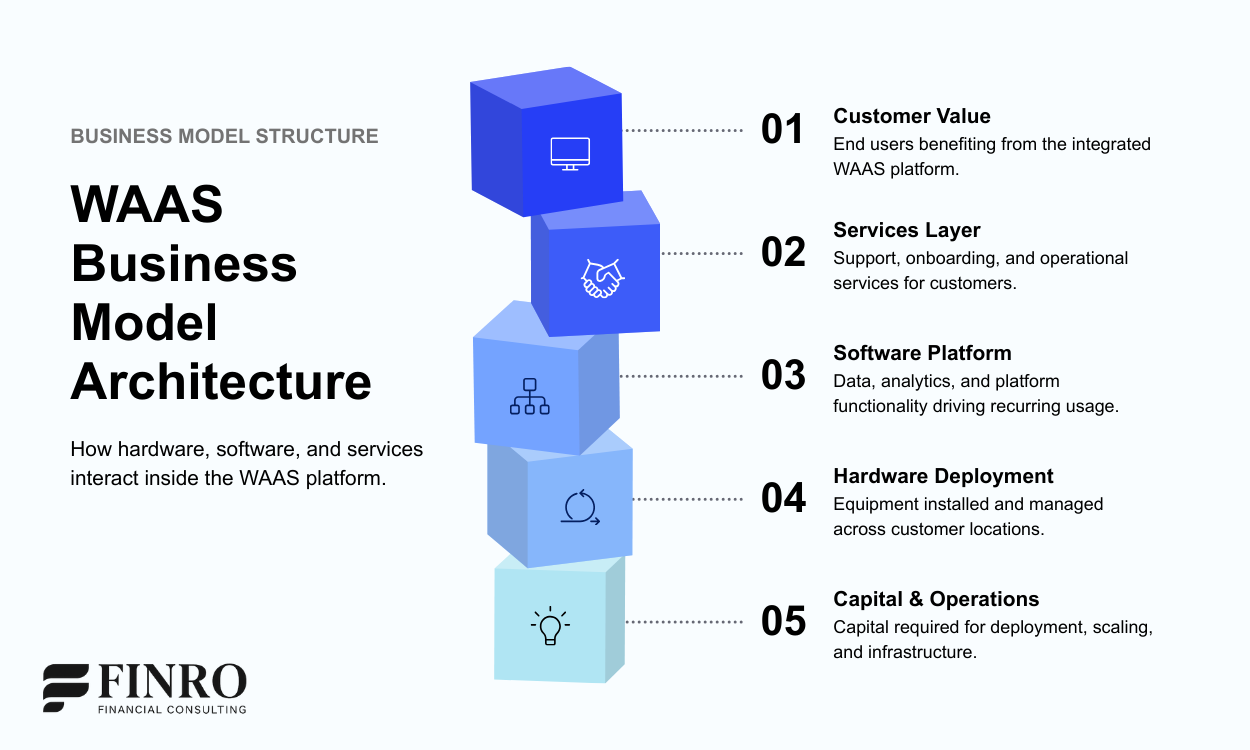
WAAS operates a B2B4C platform that combines hardware deployment, a software platform, and ongoing customer services. This structure creates a powerful product offering, but it also introduces several layers of complexity when translating the business into a financial model.
Unlike pure SaaS businesses where revenue is typically driven by subscriptions or usage, WAAS’s model involves the deployment of physical equipment alongside recurring software access and operational support. Each layer affects revenue timing, cost structure, and capital requirements in different ways.
For example, hardware deployment introduces upfront costs and asset management considerations, while the software platform generates recurring revenue tied to usage and customer retention. At the same time, the services layer supports ongoing operations and customer experience but adds additional cost dynamics that must be reflected in margins.
When these elements are not clearly separated inside a financial model, projections can quickly become difficult for investors to interpret. Revenue may appear smooth on the surface, but the underlying drivers of growth and cost scaling remain unclear.
The objective of the modeling work was therefore to restructure the financial framework so that each operational component of the business could be understood independently while still showing how the full system works together.
Why the Original Financial Model Was Difficult to Use
When the initial financial model was reviewed, the main issue was not the presence of incorrect formulas or missing calculations. The challenge was structural. The model did not clearly reflect how the different components of the business interacted or how they affected the company’s financial trajectory.
Because WAAS operates across hardware deployment, software usage, and ongoing services, each layer of the business introduces its own revenue dynamics and cost structure. When these elements are modeled together without clear separation, it becomes difficult to understand which drivers actually determine growth and margins.
One of the first challenges involved revenue structure. The projections combined several revenue streams into a single growth curve without clearly linking them to the operational activities generating that revenue. Hardware deployment, platform usage, and services were all represented inside the forecast, but the underlying mechanics connecting these activities to revenue expansion were not fully visible.
Cost structure presented a similar issue. Some operational costs were modeled as simple percentages of revenue rather than being tied to the specific activities that drive those costs. For example, infrastructure, customer support, and operational scaling behave very differently as the business grows. Without modeling these relationships explicitly, it becomes harder to evaluate how margins evolve over time.
Another important limitation involved capital planning. Hardware deployment introduces capital requirements that depend on the pace of customer adoption and the operational capacity of the company. When capital needs are not directly linked to these operational drivers, the financial model can show a runway estimate without clearly explaining how capital supports the company’s expansion.
These challenges are common in early-stage financial models. Many projections focus primarily on revenue growth while the underlying operational mechanics remain implicit. For investors evaluating a business model, however, understanding how revenue is generated and how costs scale is often more important than the growth curve itself.
The objective of the modeling work was therefore to restructure the financial framework so that each component of the business could be clearly understood and evaluated.
Where hybrid startup financial models usually break
WAAS was not a clean SaaS model. The business combined customer acquisition, hardware deployment, platform usage, and ongoing services, so the model needed to show how those mechanics worked together.
Revenue streams were visible, but not operationally separated
Hardware, software, and service revenue cannot be treated as one blended forecast. Each stream has different timing, margin behavior, and scaling logic.
Deployment capacity was not clearly linked to growth
In a hardware-enabled model, revenue depends on rollout speed, installation capacity, and operational readiness, not only customer demand.
Costs were too broad for investor diligence
Percentage-based cost lines can hide the real economics of support, logistics, hardware servicing, infrastructure, and account operations.
Capital needs were not tied tightly enough to rollout mechanics
Runway matters, but investors also need to see what the next funding round enables: more deployments, faster adoption, or stronger operating capacity.
Rebuilding the Financial Model Framework
Once the limitations of the original model were identified, the next step was to redesign the financial framework so that it reflected the actual operating mechanics of the business.
The objective was not simply to adjust projections. Instead, the model was rebuilt around the drivers that determine how WAAS acquires customers, deploys hardware, generates recurring revenue, and scales its operations.
The first step involved separating the revenue streams. Rather than projecting a single growth curve, revenue was structured around the activities that generate it. Hardware deployment, software usage, and service components were modeled independently so that each layer of the business could be evaluated on its own terms. This made it possible to understand how changes in adoption rates, pricing, or customer behavior affect the company’s overall growth trajectory.
The next step focused on operational cost structure. Infrastructure, support operations, and deployment costs were connected to the operational drivers that generate those costs. Instead of using broad percentage assumptions, the model was structured to reflect how these costs evolve as customer adoption increases and the installed base expands.
Capital planning was also integrated directly into the framework. Because hardware deployment requires upfront investment, the model needed to connect customer growth with the capital required to support that expansion. Linking deployment pace to capital requirements allowed the model to show not only revenue potential, but also the funding needed to sustain growth.
Finally, the model incorporated scenario analysis so that different growth paths could be evaluated. Changes in customer acquisition pace, deployment capacity, and operational scaling could be tested directly within the model, giving both the company and potential investors a clearer understanding of how the business behaves under different conditions.
When these components were combined, the financial model became more than a projection. It became a structured representation of how the WAAS business operates and how it scales.
What Changed in Investor Conversations
Once the financial model was rebuilt around the operational mechanics of the business, the quality of investor discussions changed noticeably.
Instead of focusing primarily on headline projections, conversations began to center on the drivers behind the numbers. Investors could see how customer acquisition translated into hardware deployment, how platform usage generated recurring revenue, and how operational scaling affected margins over time.
This structural clarity made it easier to evaluate the company’s growth trajectory. Because revenue streams were modeled separately and cost dynamics were tied to operational activity, investors could better understand how different parts of the business contributed to overall performance.
The improved visibility into unit economics also played an important role. Rather than relying on high-level assumptions about margins, the model showed how profitability evolves as the installed base expands and operational efficiency improves.
Capital planning also became easier to communicate. By linking hardware deployment and operational scaling directly to capital requirements, the model provided a clearer view of how funding supports the company’s next stage of growth.
In practice, this meant that investor discussions moved away from debating the shape of the forecast curve and toward evaluating the mechanics of the business itself.
For a company operating a multi-layered model like WAAS, that shift in focus is critical. When the underlying drivers are visible, investors can assess both the opportunity and the risks with far greater confidence.

We worked with Lior Ronen and Finro to rebuild our WAAS financial model and make it Series A-ready.
Lior quickly understood the complexity of our B2B4C rental model combining hardware, software, and services, and translated it into a clear and scalable financial framework.
The result is a robust, investor-ready model that truly reflects how our business operates and grows.
Preparing for a financial modeling decision?
Share your stage and context. We’ll outline how the model should be structured, which assumptions matter most, and where investor scrutiny will concentrate.
- 1 Complex business models need structured financial modeling. Companies that combine hardware, software, and services cannot rely on a simple revenue projection. Each layer needs its own operating logic so investors can see how growth and margins evolve.
- 2 Revenue drivers should reflect real operational activity. Separating hardware deployment, platform usage, and service revenue makes it easier to understand how adoption, usage, and customer behavior translate into financial outcomes.
- 3 Cost structure needs to follow operating mechanics. Infrastructure, deployment, and support costs scale differently as the installed base grows. Modeling those relationships explicitly gives investors better visibility into future margins.
- 4 Capital planning should be connected to growth. For businesses that require hardware deployment or operational expansion, capital needs should be linked directly to customer adoption, deployment pace, and operating capacity.
- 5 A clear financial model changes investor conversations. When the drivers behind revenue, costs, and capital requirements are visible, discussions move away from debating projections and toward evaluating the business mechanics.
Related Articles
Additional resources on investor-ready financial models, startup forecasts, and financial modeling services.